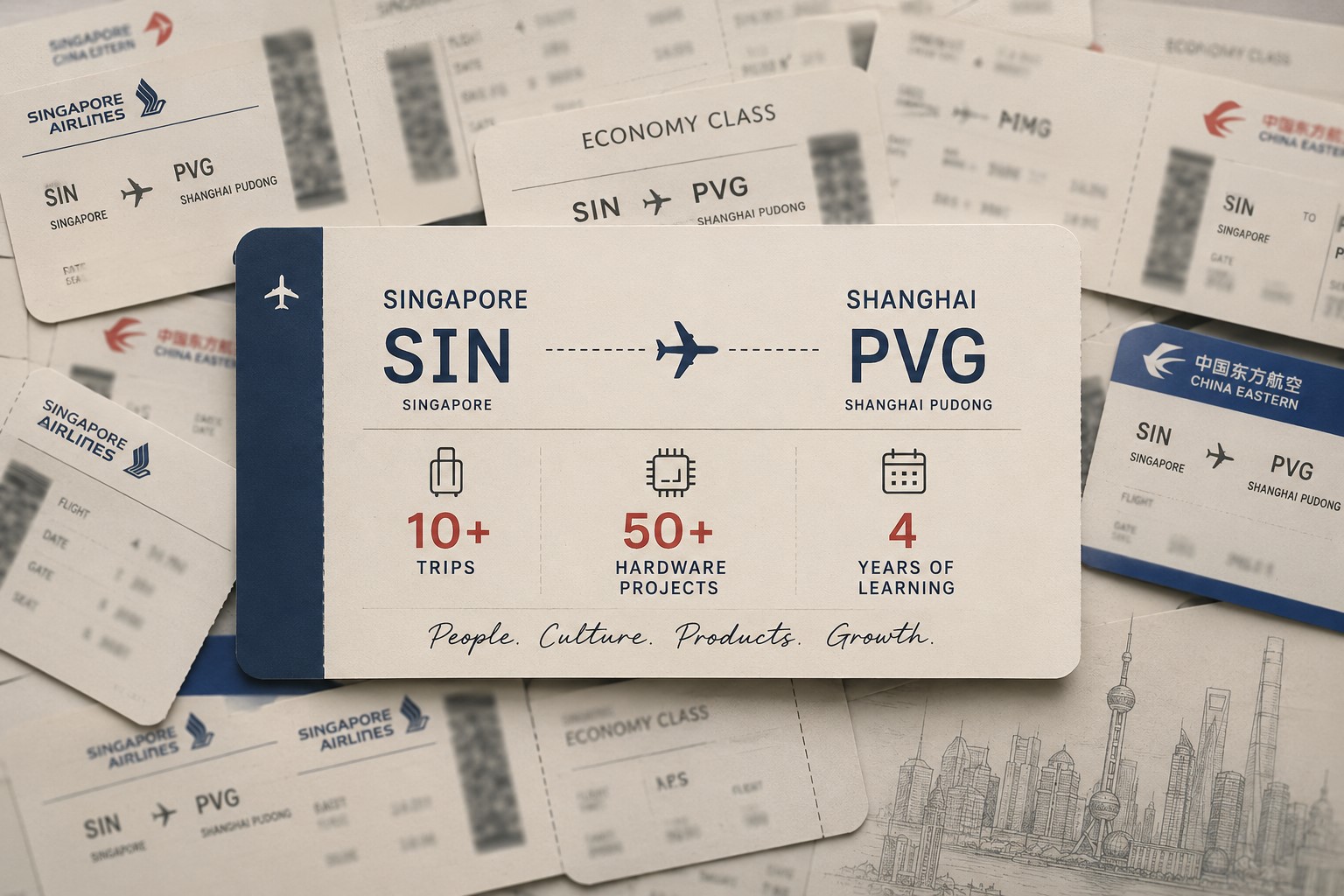
Lessons from 50+ Hardware Projects and 10+ Trips to Shanghai
Over the past four years, I’ve made more than ten trips to Shanghai and worked on over fifty embedded hardware product projects.
Like many engineers, I thought I was travelling there to learn how to build better products. I didn’t expect it to change the way I think about people, culture, and collaboration.
Great Products are Built by Great Teams
I’ve always been excited to visit Espressif’s headquarters, the birthplace of the ESP32. There was something incredibly rewarding about working alongside the people behind the chips, open-source software solutions, and development frameworks that power millions of devices around the world. When an idea comes up during a discussion, the people designing the silicon, building the software stack, and developing applications are often just a few desks away. The feedback loop is remarkably short, making it possible to build more interesting products and experiences for customers.
It taught me my first lesson: great products aren’t built by individuals. They’re built by great teams.
Working on hardware products has also taught me that speaking the same language doesn’t always mean understanding one another.
Same Language, Not Same Culture
Although I come from a Chinese-speaking family, I quickly realised that technical Chinese was an entirely different language. There were unfamiliar engineering terms, colloquial expressions unique to Mainland China, and conversations that seemed to happen at twice the speed I was used to. More than once, I found myself silently translating what I had just heard before attempting to contribute to the discussion.
Over time, I learnt that communication is far more than vocabulary. It’s about understanding how people think, explain ideas, disagree respectfully, and arrive at decisions together. Adapting my communication style became just as important as improving my technical knowledge.
Perhaps one of the biggest surprises for me had nothing to do with engineering at all.
Coming from Singapore, I didn’t realise how fortunate I was to be able to live close to my family while pursuing a meaningful career. Many of my colleagues came from all parts of the country, some travelling home only after taking domestic flights despite how extensive the high-speed rail network has become. It made me realise that urban migration isn’t unique to one country. We see it happen across large economies all over the world.
As people leave their hometowns for opportunities elsewhere, they also leave behind their families, social circles, and support systems. Naturally, colleagues become much more than people you work with. Weekend gatherings are common. Some colleagues live in the same apartment complexes, while others share accommodation together. The boundaries between work and life are often much more fluid than I was used to in Singapore.
What began as colleagues eventually became friendships outside of work.
These experiences reminded me that people don’t leave their personal experiences at the office door. They bring them into the products they build, the decisions they make, and the relationships they form.
Learning How People Work
After returning to Singapore from one of my longer work assignments, I had a one-on-one conversation with our HR Director who recommended that I read The Culture Map by Erin Meyer. It remains one of my favourite books on cross-cultural collaboration.
The book describes how differently people around the world communicate, make decisions, and approach disagreements. Some meetings feel energetic and spontaneous, while others are formal and deliberate. Some cultures are more direct, while others rely heavily on context and relationships.
Looking back, I realised I wasn’t struggling with language barriers. I was learning how to communicate across cultures.
International Teams are Cross-Cultural Teams
As a project manager facilitating discussions between colleagues from Singapore, India, China, and Europe, I continue to remind myself that managing projects isn’t simply about managing timelines, budgets, and deliverables. It’s equally about creating understanding between people who think differently and bring unique perspectives to the table.
Being a project manager has taught me that successful projects are often less about having the perfect plan, and more about helping people move towards the same goal together.
Observations of 996, TangPing and NeiJuan
Having worked during a period when buzzwords such as 996, Tangping (lying flat), and Neijuan (involution) frequently appeared in conversations and media reports, I would also like to share a few personal observations. These experiences are entirely my own. The reality, at least from what I observed, is often more nuanced than the headlines suggest.
While overtime certainly exists, I found that work cultures vary greatly between companies and industries. Personally, I probably worked closer to a 10-10-5 schedule during my time there. At the same time, I frequently found suppliers replying to messages late into the evening, and some worked on Saturdays. Efficiency and speed are highly valued, and that pace can naturally create longer working hours.
Tangping emerged as a response to burnout and changing economic realities, much like the “quiet quitting” conversations we saw elsewhere around the world. Personally, I did not experience much of this among my immediate colleagues, who remained incredibly driven and passionate about their work. However, conversations with taxi drivers and people outside of work often provided a different perspective, reminding me that economic transitions affect people in very different ways.
Neijuan was perhaps the most interesting observation for someone working in product development. Competition has become increasingly intense across almost every industry. Cost, efficiency, and speed are no longer enough on their own. Proper product differentiation to appeal to target users has become more important than ever. This drive towards continuous improvement extends beyond products. It applies equally to the people building them.
Four Years Later
Four years later, I’ve had the privilege of main-authoring a Chinese patent, understanding most Chinese memes without needing an explanation, and finding myself well assimilated into a culture that once felt unfamiliar. More importantly, many of the colleagues I met along the way have become close friends outside of work.
I thought I came here to learn how products are built. Instead, I learnt just as much about how people are built.
Takeaways
Great products require great teams. Great teams require understanding people.
Engineering may connect devices, but it’s people that connect ideas. Building great products starts with understanding both.